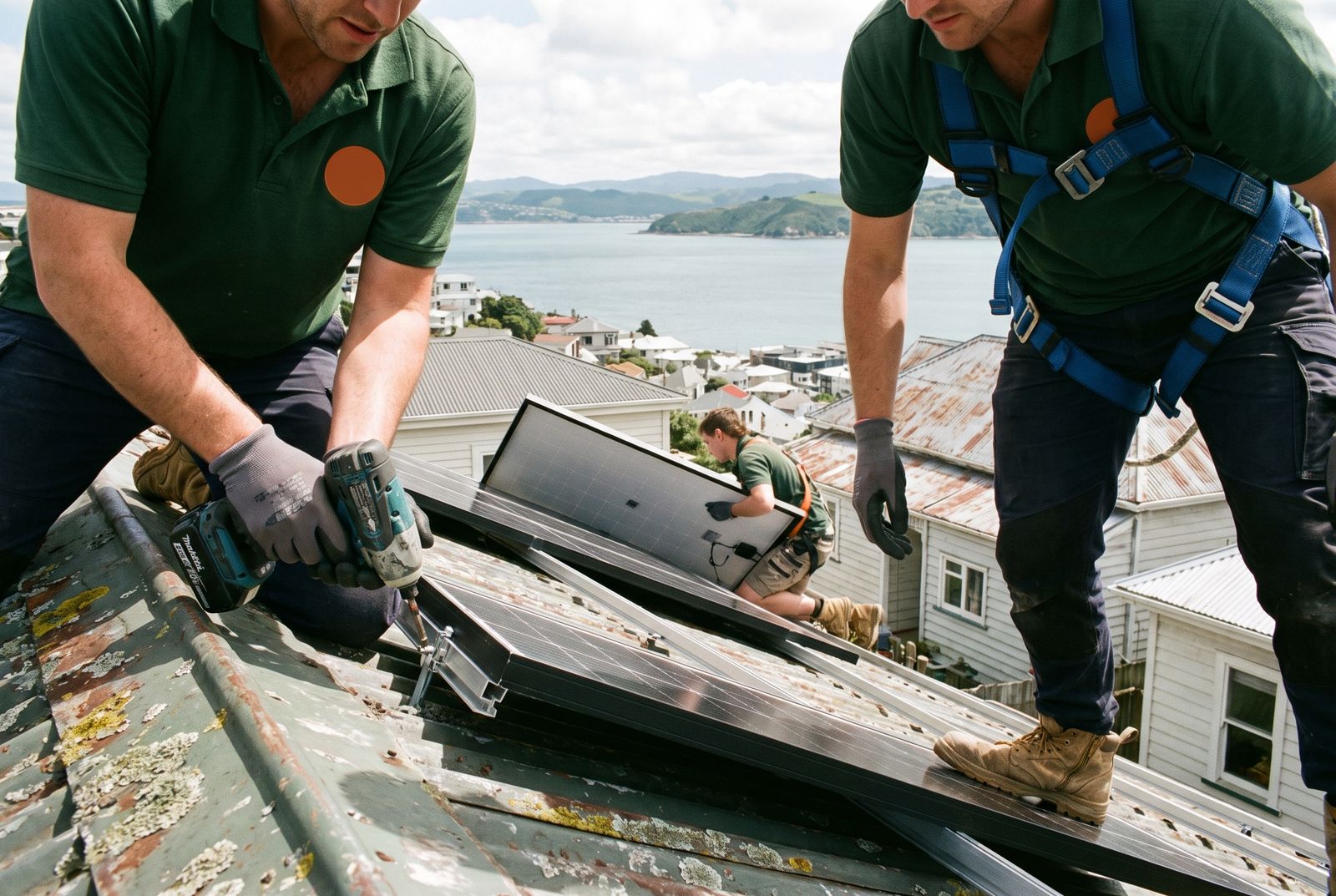
Solar can bring your power bill down, but it does not suit every house. The return depends on your roof, the shade around it and how much power you use while the sun is up. We look at those first, then design, install and connect a system sized for your household rather than the most panels the roof will hold.
In Wellington there are two extra questions most other cities do not ask as often: what wind zone your roof sits in, and how the lines company now handles export at busy times. We cover both below. Solar also pairs well with daytime EV charging, so see our EV charger installation page if a car is on the list.
Pricing: a free quote and a fixed price agreed before we start. You get a written, itemised quote, and small jobs can be quoted from photos.
Is solar right for your home?
EECA's guidance says north-facing roofs work best. East and west-facing roofs produce less and pay back more slowly, but can still be suitable. Shade from trees, chimneys, neighbouring houses and the hills themselves cuts output, which matters on steep streets and in valley suburbs where a ridge can block low winter sun. We check shade at different times of day. In the right circumstances, EECA says a system can pay for itself in as little as seven years.
When you use power matters most. Solar produces nothing at night and the most around midday. Standards New Zealand's homeowner guidance notes that power used on site is usually worth more than power exported, because retailers pay less for export than they charge you to buy. Homes that run the dishwasher, hot water or EV charging in daylight get the most value.
- Roof direction: north is best, east and west can work
- Shade from hills, trees and buildings across the seasons
- How much power you use in daylight hours
- Switchboard condition and single or three-phase supply
Wind zones and building consent
Since 23 October 2025, Schedule 1 of the Building Act has exempted many roof-mounted solar arrays from building consent. Building Performance explains that arrays up to 40 square metres in total, in a wind zone no greater than High, are exempt. Larger arrays, or arrays in higher wind zones, can also be exempt when the design is carried out or reviewed by a Chartered Professional Engineer.
That wind zone condition is where Wellington differs. Wind zones under NZS 3604 run from Low to Extra High, and many Wellington sites are in High, Very High or Extra High zones, with some needing specific design. Wellington City Council publishes wind zone maps for its urban area, and your LIM may state your zone. We confirm it before design, and if your roof is above High we bring in an engineer so the array is fixed for the loads it will actually see.
How It Works
Grid connection and the new export limits
Solar cannot simply be wired into your switchboard and start exporting. Under Part 6 of the Electricity Industry Participation Code, distributed generation needs an application to your lines company, and approval, before connection. In Wellington, the Hutt Valley and Porirua that is Wellington Electricity: for systems of 10 kW or less you apply online before installing, build to its connection standards, then send it the Record of Inspection and Certificate of Compliance.
From 11 May 2026 Wellington Electricity moved to flexible export limits. Instead of a fixed 10 kW, it uses a price signal asking owners to drop export to 5 kW when parts of the network are congested, and a congestion charge goes to your retailer for export above the published threshold. Using more of your own power, or adding a battery, avoids it. On the Kāpiti Coast, Electra runs its own approval process with separate tiers for systems up to and above 10 kW.
- Application lodged before any work starts
- Wellington Electricity for Wellington, Hutt Valley and Porirua
- Electra for the Kāpiti Coast
- Export buy-back rate agreed with your retailer
Inverters, batteries and the switchboard
The inverter turns the panels' direct current into the alternating current your house uses, and it must suit your supply: Standards New Zealand's guidance highlights matching it to a single or multi-phase home. Older switchboards may need space or an upgrade to take the solar supply safely.
A battery stores daytime surplus for the evening and, set up correctly, can keep some circuits running in an outage. With flexible export limits now in place, a battery can also reduce how often you export into a congested network. Batteries add real cost, so we model whether one pays for your usage or is better added later.
Character homes and DIY panels
The consent exemption still requires compliance with the Building Code and your district plan. Wellington City Council's 2024 District Plan includes character precincts, so if your villa or cottage is in Thorndon, Mt Victoria or Newtown, check whether a precinct applies before panels go on a street-facing roof.
Standards New Zealand's free guide, SNZ PAS 6014:2025, warns about DIY installs and illegal plug-in panels. Solar arrays produce direct current that does not switch off with the main switch, so faults can stay live. Ask any installer, including us, where the isolators are and what happens in a fire or outage.
Why Choose Cheeky's Electrical for Solar Panels
Wind zone checked first
We confirm your zone before design and involve an engineer where the exemption needs one.
Grid application handled
We lodge with Wellington Electricity or Electra and connect only once approved.
Sized to your usage
We size the system to when you use power, with export limits factored in.
One fixed, itemised quote
Panels, inverter, any battery, mounting and board work priced line by line.
Solar Panels FAQs
Do I need a building consent for solar in Wellington?
Often not. Arrays up to 40 square metres in a wind zone no greater than High are exempt. Many Wellington roofs sit in higher zones, where the exemption can still apply if a Chartered Professional Engineer designs or reviews the fixings. Check with your council if you are unsure.
What are the new Wellington Electricity export limits?
From 11 May 2026, Wellington Electricity uses a price signal asking owners to cut export to 5 kW when parts of the network are congested. A congestion charge applies above the published threshold, and more self-use or a battery avoids it.
Who approves my connection on the Kāpiti Coast?
Electra, the Kāpiti and Horowhenua lines company. It approves, asks for changes or declines before the system is connected.
How long does solar take to pay back?
EECA says as little as seven years in the right circumstances. Roof direction, shade, daytime use and your export rate all move that figure.
Do I need a battery?
Not always. It helps if you use a lot of power in the evening, want outage backup, or want to avoid exporting at congested times. We model both options.
Can I fit plug-in solar panels myself?
Standards New Zealand's guidance warns against DIY setups and illegal plug-in panels. Solar should be installed and connected by licensed professionals.
Solar Panels Near You
Find your region or suburb for local solar panels information:
Related Electrical Services
Solar Panels Guides
- Is Solar Worth It in Wellington? Sun, Wind and Payback
- Do You Need Surge Protection? Power Surges, Storms and Your Switchboard
- Electrical CoC and ESC: What You Should Get After Electrical Work
- Selling Solar Power Back in Wellington: Export Limits and Buy-Back Rates
See the electrician prices guide or every service we offer.
Sources and further reading
- EECA: Is solar right for your home?
- Building Performance: Solar panel and boundary setback building consent exemption changes
- Standards New Zealand: Free residential solar guidelines (SNZ PAS 6014:2025)
- Wellington Electricity: Small systems of 10 kW or less
- Electra: Distributed generation
- Electricity Authority: Maximising benefits from local electricity generation
- Level (BRANZ): Wind zones
- Wellington City Council: NZS 3604 wind zones dataset
- Wellington City Council: District Plan decisions