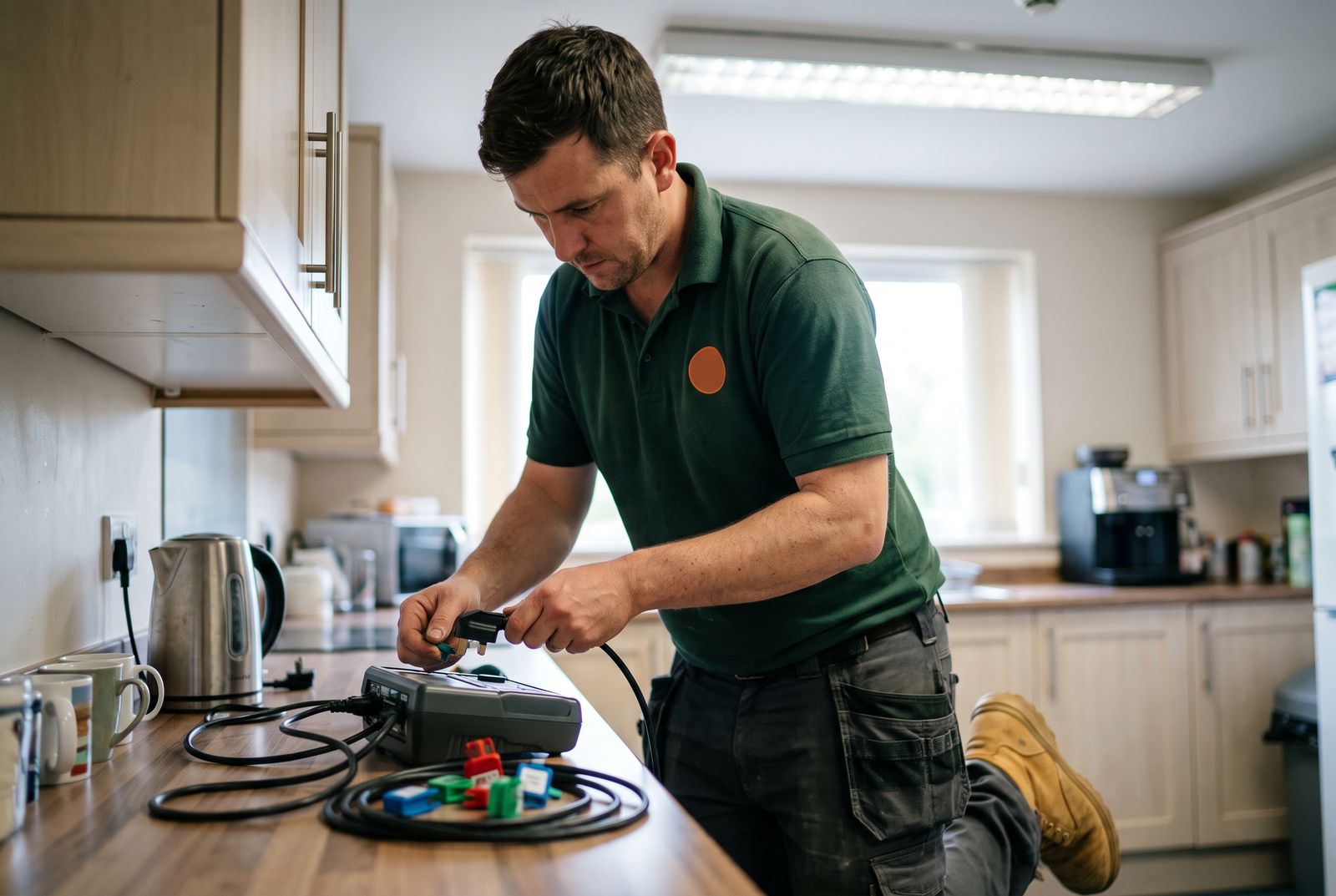
Test and tag is the routine inspection and testing of plug-in equipment: kettles, computers, power boards, extension leads, power tools and anything else on a flexible cord. Every item that passes gets a tag showing when it was tested and when it is next due.
We test offices in the central city, shops and cafes, rental properties, schools, workshops in Petone, Seaview and Porirua, and building sites from the Hutt Valley to Kāpiti. Our testers work alongside licensed electricians, so failures are not just tagged and left: we can repair or replace them on the spot. Test and tag is one part of our wider commercial electrician services.
Pricing: a free quote and a fixed price agreed before we start. You get a written, itemised quote, and small jobs can be quoted from photos.
Need the fixed wiring and switchboard of a building inspected? See electrical inspections.
Is test and tag a legal requirement?
Not on its own. WorkSafe says testing and tagging is one useful way to check electrical equipment, but it is not mandatory. What the law requires is that equipment is electrically safe and kept that way, and it is up to the person conducting the business or undertaking (PCBU) to decide how.
Test and tag is the common route because of regulation 26 of the Electricity (Safety) Regulations 2010. Where an appliance is used by an employee or contractor of its owner, it is deemed electrically safe if it carries a current tag issued under AS/NZS 3760. The Regulations currently cite the 2022 edition of that standard.
Landlords, hire gear and leased premises
Regulation 26 also covers appliances supplied to a hirer or lessee, or to the occupier of rented or leased premises, such as a heater left in a flat or a hire firm's tools. Those items are deemed safe either with a current AS/NZS 3760 tag, or if, when first made available, they are supplied through a portable RCD or an RCD-protected circuit giving shock protection.
For Wellington landlords, whether you own a flat in Kelburn or a unit in Te Aro, that means a choice: tag the supplied appliances, or make sure they are on RCD-protected circuits. We can test the RCDs at the switchboard and tell you which route suits the property.
How It Works
What we test
AS/NZS 3760 covers low voltage equipment connected by a flexible cord or plug, including extension sets, portable outlet devices such as power boards, and portable RCDs. Every item gets a visual check first: damaged cords, cracked plugs, missing earth pins and scorch marks fail before a meter is connected. Then we run the electrical tests the standard calls for, and push-button test portable RCDs.
Test and tag is not the right check for EV charging gear. WorkSafe warns a tag does not make modified EV cables safe, because the standard was written for tools and leads. Chargers are covered on our EV charger installation page.
- Kitchen appliances: kettles, toasters, microwaves, fridges
- IT equipment: computers, monitors, printers, chargers
- Power boards and extension leads
- Power tools and site equipment
- Portable RCDs
How often to retest
WorkSafe says frequency depends on the equipment and the workplace. Tools used outdoors and in damp conditions on a construction site need testing far more often than a computer on an office desk. AS/NZS 3760 sets recommended intervals for different environments, and AS/NZS 3012 covers electrical safety on construction and demolition sites.
Wellington adds its own wear and tear. Winter is the wettest season, and leads dragged across wet scaffold planks or left coiled in a site container get damaged faster. We set the retest date for each item based on where it is used, record it in your register, and remind you before the next round. Between tests, WorkSafe advises checking cords, plugs and tools for damage, and keeping outdoor gear on RCD protection.
Who can test, and what happens to failures
WorkSafe says the tester does not need to be a registered electrical worker, but must have the knowledge and skills to understand the standards. A PCBU can train a staff member or hire a third party. The catch comes next: only a registered electrical worker can fix the problems testing turns up.
That is where we differ from a testing-only service. A failed item is withdrawn from use, labelled clearly, and either repaired on the day or quoted for replacement. You get a register listing every item, its result, tag number and next test date.
- Failed items labelled and taken out of service
- Simple repairs such as plugs and cord ends done on site
- Replacements quoted where repair is not worth it
- Full register with results and retest dates
Why Choose Cheeky's Electrical for Test and Tag
Electricians, not just testers
Failures are repaired or replaced by licensed electricians, often on the same visit.
A register you can use
Every item, result, tag number and retest date, ready for an auditor or insurer.
Retest reminders
We track due dates per item and contact you before the next round.
Minimal disruption
We test desk by desk or before opening so staff keep working.
Test and Tag FAQs
Is test and tag compulsory in New Zealand?
No. WorkSafe says it is not mandatory. Equipment must be electrically safe and kept that way, and a current AS/NZS 3760 tag is one way it is deemed safe under regulation 26.
How often do appliances need testing?
It depends on the equipment and where it is used. Building site tools need testing far more often than office equipment. We set intervals per item.
Does the tester need to be an electrician?
No, but they must understand the standards. Only a registered electrical worker can fix what testing finds, which is why we use licensed electricians.
Do Wellington landlords need to test and tag?
Under regulation 26, appliances supplied with a rental are deemed safe with a current tag, or if supplied through an RCD-protected circuit or portable RCD. Either route works.
What happens if something fails?
It is labelled, taken out of use and repaired or replaced. The register records the failure and the outcome.
Can you test our EV charging cable?
Test and tag is not the right check for EV equipment. WorkSafe warns that AS/NZS 3760 tags give no assurance of EV charger safety.
Test and Tag Near You
Find your region or suburb for local test and tag information:
Related Electrical Services
See the electrician prices guide or every service we offer.
Sources and further reading
- WorkSafe: Testing and tagging electrical appliances
- Electricity (Safety) Regulations 2010, regulation 26
- Standards Australia: AS/NZS 3760 In-service safety inspection and testing of electrical equipment and RCDs
- WorkSafe: Safely charging your electric vehicle at home
- NIWA: The Climate and Weather of Wellington (2nd ed., 2014)