Every circuit in your home starts at the switchboard, and so does its protection. A lot of Wellington houses, from Newtown cottages to post-war state homes in Naenae and Porirua, still have rewireable fuses or an early breaker board with little or no RCD protection and no spare room for an EV charger, a heat pump or an induction cooktop.
This page covers the board itself: when it is due, what goes into the new one, how it should be mounted in a city that shakes, and how the inspection and certificates work. If the cables running out to the rooms are also original, our rewiring page covers that side.
Pricing: a free quote and a fixed price agreed before we start. You get a written, itemised quote, and small jobs can be quoted from photos.
If the cables in the walls are the problem rather than the board, see house rewiring.
Signs your board is ready for replacement
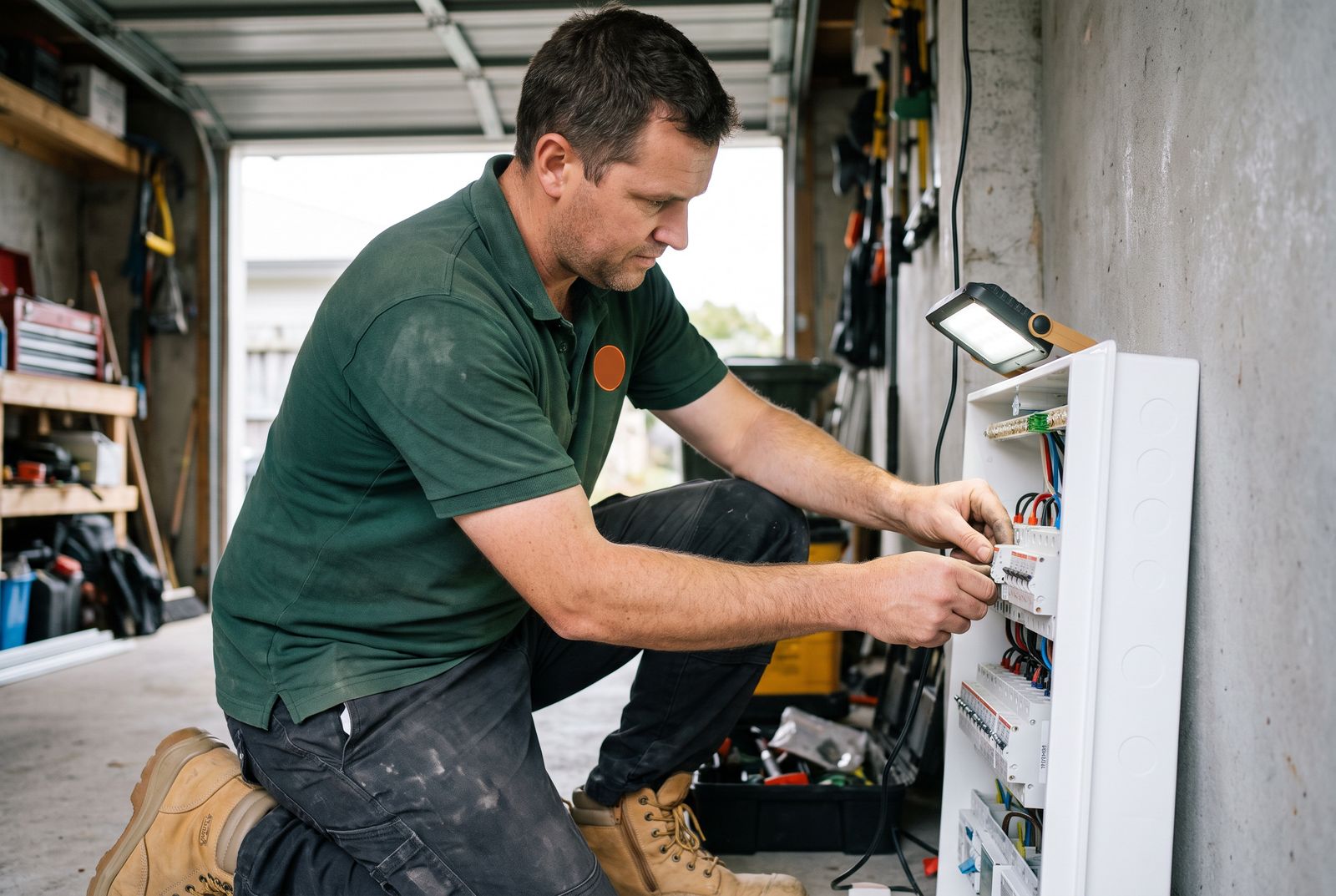
Age on its own is not a reason to replace a board, but some features are. Ceramic holders with fuse wire, an old timber or possible asbestos backing panel, scorch marks, a board that runs warm or buzzes, and no RCDs at all are the usual ones. So is a board where every slot is full and a new circuit would mean doubling up or adding a sub-board.
WorkSafe lists fuses that blow and breakers that trip for no clear reason as warning signs, and suggests replacing fuses with plug-in circuit breakers of the same rating where possible, because they are safer and need no rewiring after a fault.
- Rewireable ceramic fuses
- No RCDs, or RCDs on power circuits only
- Scorching, heat or a buzzing sound
- No spare ways for new circuits
- A board that moves or rattles on its mounting
What goes into a new switchboard
A modern board gives every circuit overload protection and RCD protection against electric shock. We usually fit RCBOs, which combine a breaker and an RCD in one device, so a fault on one circuit switches off only that circuit instead of half the house. Where budget matters more, circuits are grouped under shared RCDs.
From 13 November 2025, the version of AS/NZS 3000 cited in New Zealand law requires RCDs that provide shock protection to meet Type A requirements, or to be Type F or Type B. Every circuit is labelled, and surge protection and spare ways for future work can be added.
How It Works
Mounted for earthquake country
The Wellington Fault runs from Cook Strait through Karori and the city and along the Hutt Valley, and the region has many other active faults. A heavy old board screwed loosely to a sheet of backing timber can pull away in a strong shake, straining the cables behind it. When we replace a board we fix the new enclosure securely to the framing and make sure the cables entering it have enough slack and support.
Research on the Hutt Valley floor has found that shaking can be amplified on its deep alluvial ground towards the Petone foreshore, so a well-fixed board matters there too. It is a simple detail that costs little at install time.
Room for an EV charger, heat pumps or induction
Upgrades are often prompted by a new appliance. Each EV charging point needs its own dedicated circuit, and WorkSafe's EV charging guidelines call for a Type B RCD, or a Type A RCD with an RDC-DD, on a MEN switchboard. Induction cooktops and larger heat pumps usually want their own circuits too.
Before quoting we check the main supply, the main switch rating and the existing load. If the house needs more supply capacity, Wellington Electricity says changing capacity is one of the jobs it must be involved in, arranged through your power retailer. On the Kāpiti Coast the lines company is Electra. We tell you early if your plans need that step.
Inspection, certificates and the day itself
WorkSafe says work on the main switchboard, main cable and main earth must be inspected by a licensed electrical inspector, and the electrician arranges it. We book the inspection as part of the job. You receive a Certificate of Compliance and an Electrical Safety Certificate, and the inspector provides a record of inspection.
Power is off for most of the day, so we agree a start time that suits you. We remove the old board, fit the new enclosure, reconnect and label each circuit, and test every one before switching back on. Tests often uncover faulty circuits the old fuses were hiding, and we tell you before fixing anything extra.
What drives the price
The main factors are the number of circuits, RCBOs or shared RCDs, the condition of the existing circuits, whether the board moves, and extras such as surge protection or new EV and cooktop circuits. Asbestos backing panels need extra care, and hillside homes with steep or no vehicle access can add time.
We look at your board, or a few clear photos of it, and give you a written, itemised fixed price that includes the inspection and certificates. Our electrician prices guide explains typical cost factors in more detail.
Why Choose Cheeky's Electrical for Switchboard Upgrades
Inspection included
We arrange the licensed inspector and all the certificates, so you have one price and one contact.
Fixed firmly to the frame
New boards are secured properly with supported cable entries, which matters in a region with active faults.
Built for what comes next
We leave spare ways for the EV charger, heat pump or cooktop you are planning, not just today's circuits.
Every circuit labelled
Each circuit is tested and clearly marked, so nobody has to guess which breaker runs the kitchen.
Switchboard Upgrades FAQs
Do I have to upgrade my old fuse board?
No law forces a safe existing installation to be upgraded. WorkSafe says existing installations can continue and be repaired as long as they are not unsafe. Many owners upgrade for RCD protection and capacity.
What is the difference between an RCD and an RCBO?
An RCD protects against electric shock and can cover several circuits. An RCBO combines RCD and overload protection for one circuit, so a single fault only turns off that circuit.
Does a switchboard upgrade need an inspection?
Yes. Work on the main switchboard must be inspected by a licensed electrical inspector. We arrange it.
Do I need more supply from the lines company?
Sometimes, for example for a large EV charger plus induction. Capacity changes go through your retailer and the lines company, which is Wellington Electricity in Wellington, the Hutt and Porirua, and Electra on Kāpiti.
How long will the power be off?
For a typical house, most of a working day. Your quote states the expected time and we plan around fridges and home offices.
Can the board be moved during a renovation?
Yes. Moving the main board or meter can involve your retailer and lines company, so we plan it early.
Switchboard Upgrades Across Wellington
We cover every region: Central Wellington, Eastern and Southern Suburbs, Western and Northern Suburbs, the Hutt Valley, Porirua, the Kāpiti Coast.
Related Electrical Services
Switchboard Upgrades Guides
- Is Solar Worth It in Wellington? Sun, Wind and Payback
- Old Wiring in Wellington Houses: Rubber, TRS and Wire Colours
- Trees, Wind and the Power Line to Your House: Who Is Responsible?
- Old Fuse Box in a Wellington Villa? Signs It Needs Replacing
See the electrician prices guide or every service we offer.
Sources and further reading
- WorkSafe: Getting electrical work done
- WorkSafe: Electrical wiring in your home
- WorkSafe: Changes to Electricity Safety Regulations for electrical installations (19 December 2025)
- WorkSafe: Addendum to EV Charging Safety Guidelines, 3rd edition
- Wellington Electricity: Getting connected
- Electra Limited (Wikipedia)
- Wikipedia: Wellington Fault
- Site amplification study, Hutt Valley (NSF public access repository)