Most new EV owners start with the portable cable that came with the car, plugged into an ordinary socket. WorkSafe notes these supply up to 10 A: fine for topping up or a small battery overnight, slow for a big battery that is nearly flat. A wall charger is faster, safer for daily use, and can be scheduled for cheaper overnight power.
We install home chargers in garages, carports, car decks and driveways across Wellington, Porirua, the Hutt Valley and the Kāpiti Coast. Before you buy a unit, read our guide to the best home EV chargers in NZ.
Pricing: a free quote and a fixed price agreed before we start. You get a written, itemised quote, and small jobs can be quoted from photos.
What the safety guidelines require
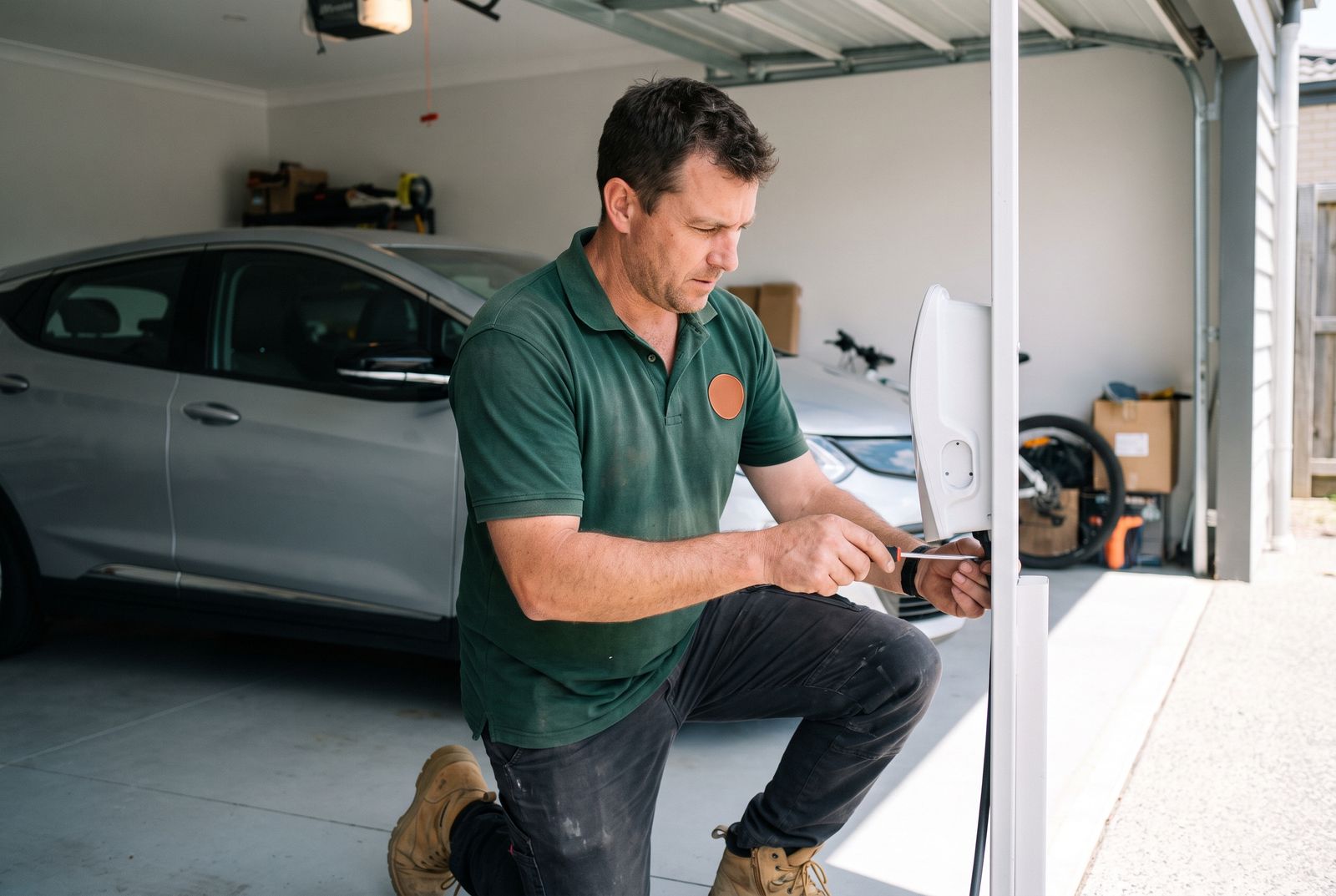
WorkSafe's EV charging safety guidelines set out how a home charger must be installed. Each charging point needs its own dedicated final subcircuit. Under the 3rd edition addendum, that subcircuit must be protected by a Type B RCD and must start from a switchboard on a MEN (multiple earthed neutral) system. A Type A RCD combined with an RDC-DD to IEC 62955 is an accepted alternative.
Two points trip people up. A Type B RCD built into the charger does not replace the protection required on the circuit. And WorkSafe's consumer guidance says the Type A RCDs found in many houses do not cover every fault an EV or charger can produce. A wall-mounted unit must be installed by a registered electrician.
- Dedicated final subcircuit for each charging point
- Type B RCD, or Type A plus an RDC-DD to IEC 62955
- Circuit starts from a MEN switchboard
- Installed by a registered electrician, with a Certificate of Compliance
Your switchboard and your supply
A charger is one of the largest loads a house will carry, often for hours at a stretch. WorkSafe warns that older wiring may need upgrading, because high-draw devices create heat, a fire risk in wiring never designed for it. Old fuse boards, boards with no free space and boards with no RCDs usually need a switchboard upgrade first, and we check all three at the quote.
Sometimes the question goes past the board to the connection itself. Wellington Electricity, which runs the lines network for Wellington, the Hutt Valley and Porirua, says it must be involved when a property changes its supply capacity, and that request goes through your power retailer. On the Kāpiti Coast the lines company is Electra. Most homes never need this, but we will tell you early if yours might.
How It Works
Hill sections, car decks and street parking
Wellington's slopes shape where cars park. Wellington City Council notes that the city's topography often means using the road reserve for a car deck, garage or steps. On a hill section in Kelburn, Brooklyn, Hataitai or Ngaio, the parking spot can be at street level, a long way from a switchboard in the house below. That distance, and the route the cable takes, sets most of the price.
We run cable through the subfloor, along the structure in protected routes or in conduit underground, and fit a weatherproof charger where it will face rain and wind. EECA notes you cannot run a charging cable across a public footpath to a car parked on the street, so a home without off-street parking may need another plan. We will tell you honestly if a charger is not practical at your address.
- Inside a garage beside the switchboard
- Street-level garage or car deck above or below the house
- Carport or driveway, with an underground cable run
- Townhouse or apartment car parks, after body corporate approval
Choosing a charger
Gen Less says smart wall chargers are at least three times faster than a 3-pin plug and can load balance, turning down automatically when the rest of the house is drawing a lot of power. That matters most on older wiring. EECA also publishes a list of recommended smart chargers selected for energy efficiency and grid smartness.
Most homes are single-phase, which caps a home charger at about 7 kW. Three-phase supply allows faster charging, but few houses have it and few cars use it at home. We will tell you plainly whether a bigger unit would charge your car any faster.
Buy a charger that is legal in New Zealand
Electric vehicle supply equipment is a medium-risk declared article, so New Zealand suppliers must hold a Supplier Declaration of Conformity (SDoC). WorkSafe suggests asking for a copy before you buy and passing it to your electrician. If the seller cannot supply one, do not install the unit until its safety is confirmed.
WorkSafe also warns against chargers and leads built for overseas supply systems and refitted with a New Zealand plug. A test and tag label does not make modified EV gear safe, because AS/NZS 3760 is meant for handheld tools and leads. Never charge through a household double adaptor or multi-box.
Why Choose Cheeky's Electrical for EV Charger Installation
Protection done to the guidelines
Every charger goes on a dedicated circuit with Type B RCD protection, or Type A plus an RDC-DD.
Board and supply checked first
You know before you commit whether the switchboard or connection needs work.
Used to awkward hill sites
Long runs to street-level garages and car decks planned and priced up front.
One fixed price
Charger install, cable run and any board work itemised on one written quote.
EV Charger Installation FAQs
Do I need a Type B RCD for an EV charger?
WorkSafe's guidelines require the charger's circuit to be protected by a Type B RCD, or a Type A RCD with an RDC-DD to IEC 62955. A Type B RCD inside the charger does not replace that.
My garage is at the street and the house is below. Can you still do it?
Usually, yes. It is a longer cable run, through the subfloor, along the structure or underground, and we price the route at the quote.
Will I need a switchboard upgrade?
Sometimes. Old fuse boards, full boards and boards with no RCDs often need work. We check before quoting.
Does Wellington Electricity need to be involved?
Only if your supply capacity has to change. Wellington Electricity says capacity changes need its involvement, arranged through your retailer. Electra covers the Kāpiti Coast.
Can I keep charging from a normal power point?
Yes, with the manufacturer's cable plugged straight into the socket. WorkSafe says these supply up to 10 A. Never use an extension lead or double adaptor.
What paperwork do I get?
A Certificate of Compliance for the new circuit, plus the charger's warranty and setup details. Keep the supplier's SDoC with them.
EV Charger Installation Across Wellington
We cover every region: Central Wellington, Eastern and Southern Suburbs, Western and Northern Suburbs, the Hutt Valley, Porirua, the Kāpiti Coast.
Related Electrical Services
See the electrician prices guide or every service we offer.
Sources and further reading
- WorkSafe: Addendum to EV Charging Safety Guidelines, 3rd edition
- WorkSafe: Safely charging your electric vehicle at home
- Gen Less: Buying a smart EV charger
- EECA: Smart EV chargers
- Wellington Electricity: Getting connected
- Electra: Electra Limited
- Wellington City Council: Build a retaining wall (road reserve use)